

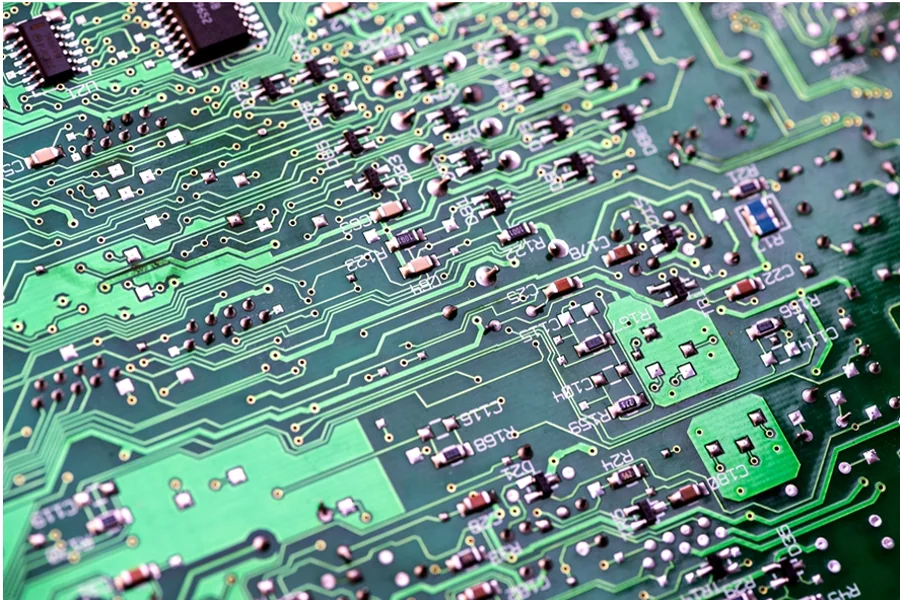
In today’s compact and high-performance electronics, innovation in PCB layout and connection design is crucial. One such specialized board design that plays a critical role in surface-mount connectivity and modular integration is the castellated PCB. This type of printed circuit board is ideal for mounting smaller PCBs as sub-assemblies on a larger board, simplifying the integration of complex functions while saving space.
The term “castellated” refers to the semi-plated holes or edges that resemble the battlements of a castle—hence the name. These notches are plated through and then cut along the board edge, forming conductive half-holes. The purpose of these castellations is to allow easy soldering of the board onto another PCB, creating reliable electrical and mechanical connections between the two. This method effectively turns the castellated PCB into a pluggable module, much like a surface-mount component.
Design and Functionality of Castellated PCB
Castellated PCBs are designed with plated half-holes or notches along one or more of their edges. These semi-holes are created by first drilling and plating full vias and then milling or routing them to create exposed half-circles. When soldered onto corresponding pads of a base PCB, they create strong joints that are well-suited for both prototyping and volume manufacturing.
The key benefit of castellated holes is their ability to streamline manufacturing and assembly. Designers can develop a fully functional module—such as a WiFi, Bluetooth, or power management module—on a castellated PCB, and later solder it onto a main board without the need for connectors or additional interposers. This simplifies the layout and allows for more compact product designs.
Additionally, castellated PCBs make testing and development much easier. Because the module can be produced and tested independently before being integrated into the final assembly, debugging and replacement become significantly less time-consuming. Developers can verify the module’s performance as a standalone unit, then mount it onto the main board for full product integration.
Where Castellated PCB Technology Is Used
Castellated PCBs are commonly used in wireless communication modules like WiFi, Zigbee, Bluetooth, and LoRa, where the module is treated as a plug-and-play solution. These modules often come pre-certified for electromagnetic compatibility (EMC), which helps reduce the need for separate compliance testing on the final product. Their castellated design allows for easy integration without redesigning the entire PCB layout.
In power electronics, castellated modules offer clean and secure interfaces between a power stage and control board. By isolating the high-power circuitry on a separate board, manufacturers can improve heat management and simplify future upgrades or changes.
Consumer electronics is another field where castellated PCBs shine. Products like smart home devices, wearables, gaming controllers, and even IoT gateways rely on such compact PCBs for modularity and serviceability. When time-to-market is critical, using prebuilt castellated modules accelerates development while maintaining flexibility.
Even in industrial and automotive applications, castellated boards are used to integrate microcontrollers, sensors, or wireless interfaces with minimal space requirements. Their repeatable and cost-effective design makes them ideal for high-volume applications where reliability is essential.
Manufacturing Considerations for Castellated PCB
Creating a castellated PCB requires specialized routing and plating capabilities. Unlike standard vias, the half-holes must be precisely aligned and plated to ensure robust solder joints and consistent electrical conductivity. Improper fabrication may lead to poor wetting, voids in plating, or inconsistent contact during reflow soldering.
Designers need to provide accurate Gerber files that clearly define the castellated area, typically using a combination of plated through-hole (PTH) and mechanical routing layers. Spacing and pad alignment are also crucial, as the solder pads on the mating board must align perfectly with the castellations for a proper connection.
During assembly, careful control of reflow temperature profiles ensures the solder forms strong and clean joints. Inspection methods like X-ray or AOI may be used to verify the integrity of the solder joints, particularly in high-reliability sectors like medical or aerospace.
The cost of manufacturing castellated PCBs is slightly higher than standard PCBs due to the added complexity of milling and plating, but the benefits in modularity and integration often outweigh the additional expense.
Partner With a Trusted Castellated PCB Manufacturer
To ensure durability, accuracy, and performance, it’s important to work with a reputable castellated pcb manufacturer who has experience in handling advanced milling and plating techniques. The right manufacturing partner will help you optimize your design for production, improve yield rates, and reduce long-term costs. Whether you’re building a wireless module, power supply, or embedded sensor system, choosing a specialized manufacturer ensures your castellated PCBs meet the highest standards of quality and performance.
